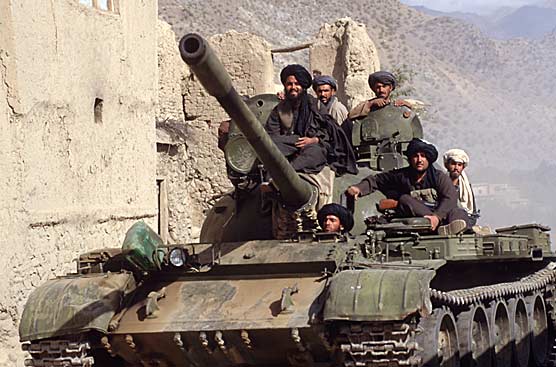
How the Taliban captured Kabul

How the Taliban captured Kabul

by Scirocco Jazz on Tuesday, May 22, 2012 at 5:51am ·
The nearly one-year Taliban campaign against Kabul in 1995 put the city under severe harm but the Taliban failed to take the city against Ahmad Shah Massoud's government forces. Instead the Taliban suffered devastating military defeats. At the same time Massoud and Rabbani were finally able to show political successes through an "intra-Afghan dialogue" bringing everyone including Dostum, Hekmatyar, Wahdat or the Jalalabad Shura to the negotiations table. Only the Taliban categorically refused to share power. Rabbani said: "This alliance can be consolidated by bringing in more opposition figures to create a peace axis and I call on others to join the process so that a formula for an interim government can be found". Pressured by Massoud, Rabbani agreed to relinquish the presidency for a new president to be elected  in a conference inclusive of all parties. Massoud told Rabbani that no party could claim the highest office and power for itself forever as shown by the Soviet example.

Considering both the military and political achievements by Massoud and Rabbani, the Taliban and their Pakistani backers decided they had to devise a strategy to ascent to power before the new understanding between the other parties could be consolidated. The  following strategies and external circumstances finally led to the capture of Kabul.

Religious symbolism
To silence unrest within its own ranks and elements which were demanding to negotiate with the Kabul government, the Kandahari elements behind Mullah Omar strictly opposed to negotiations sought to cement Mullah Omar's leadership by implying religious symbolism. After meetings which included Pakistani officials, the Kandahari Taliban mounted a religious play in April 1996, featuring Omar standing in the wind in Kandahar in the Cloak of the Prophet Muhammad taken from its shrine. The Kandaharis staged an event in which they declared Omar to be the "Leader of the Faithful" acting according to parts of the script of religious prophecy about an "army from Khorasan" which will save Islam displaying black banners. Omar was placed above the normal political business and any questions with regards to his decisions were no longer tolerated. The strategy proved successful. His decision was to wage war against the government and not to share power with anyone.

Internal spoiler Hekmatyar and over-streched defensive lines
When Hekmatyar joined the government, he and Rabbani demanded Massoud to cover the Hezb-e Islami lines as well. Hezb-e Islami commanders were either unwilling or unable to hold their own against the Taliban. Massoud initially refused to send his forces into largely unknown territory. But Rabbani and Hekmatyar increasingly put pressure on him accusing him of not wanting to act united and Hekmatyar again threatening to act as a spoiler if his demands were not to be met. Massoud finally send troops to cover the Hezb-e Islami lines. He found himself in largely unknown territory deep in Hezb-e Islami country. While his troops were unfamiliar with the area which they still needed to study, Hezb-e Islami commanders quit their positions and left Massoud's defensive lines over-streched and thinly manned.

Corruption and criminal activity by government allies
Corruption and criminal activity by some of the government's allies lead to very low morale among their forces, so that Massoud repeatedly needed to send in troop reinforcements of his own core force. The criminal activities by some also lead to an initially indifferent population.

Treason because of bribery by Pakistan
Pakistan for months desperately tried to bribe Dostum, Hezb-e Wahdat, the Jalalabad Shura and others to not make peace with the government but to join the Taliban's war instead. They largely failed. But when the Taliban approached Jalalabad instead of Kabul, they finally cracked the Jalalabad Shura. Abdul Qadir, leader of the Jalalabad Shura, fled to Pakistan taking, according to some sources, $10 million in Pakistani bribes with him. The Jalalabad Shura forces did not recover from the treason among their leadership and Jalalabad was lost to the Taliban. Kabul suddenly faced a new hostile front to the east. At the same time many Hekmatyar commanders committed treason and vacacted their positions for Taliban to take their place.

Seemingly unrestricted access to Saudi funds and Pakistani hardware
Seemingly unrestricted monetary funds were flowing to the Taliban from Saudi Arabia. Pakistan provided the military equipment. In the meantime Massoud had to cut his troops because of a shortage of money.

Pakistan army strategy: Mobile warfare
The mobile warfare employed by the Taliban during the capture of Jalalabad was a phenomena introduced as a strategy by the Pakistan army. Pakistan provided the Taliban with the necessary hardware including heavily armored pickup-trucks. The offensives themselves were planned, coordinated and led by Pakistan army advisers. Funds were coming from Saudi Arabia. As had happened in September 1995 in Herat, the Taliban when capturing Jalalabad employed mobile warfare, repeatedly outflanking their enemies, cutting them off and attacking from the rear. (Anthony Davis, Fundamentalism Reborn) In this style they were to rapidly move forward towards Kabul from all sides.

Thousands of Pakistani nationals as troop enforcements in cross-border incursions
While Taliban troops already inside the country were approaching from the south and west, Pakistan opened up its borders with thousands of Taliban troop enforcements, many Pakistani nationals or Afghan refugees, suddenly placed to the east of Jalalabad and later moving towards Kabul.

Result
The result of above strategies and general circumstances were:
1. Embolded by the religious symbolism of their leader, Taliban troops had very high morale.
2. Millions in cash were coming from Saudi Arabia, military equipment was provided by Pakistan and military campaigns were planned and led by professional Pakistan army advisers. Thousands of Pakistanis acted as troop enforcements.
3. After the capture of Jalalabad Kabul was wide open from all sides for the first time, except for a small corridor to the north. Hekmatyar had abandoned his positions to the south, Abdul Qadir had abandoned his positions to the east, Ismail Khan had been defeated to the west not least because corruption had decreased the morale among his people.
4. Massoud's defensive lines were over-streched in areas were Hezb-e Islami had formerly held its positions. Immediately after the surprising capture of Jalalabad the Taliban quickly moved towards Kabul  from all sides, also trying to cut off the small northern corridor. When the Taliban approached the Hezb-e Islami areas with their rapid mobile warfare, this led to a disorderly retreat by over-streched government forces which in turn led to confusion.
5. Although morale was high among Massoud's troops in his core territories, he foresaw that reestablishing a defensive line, including troops which were in confusion and retreat, for Kabul on four fronts against a mobile warfare force with a working air force rapidly approaching from all sides, if possible, would cause destruction and bloodshed maybe worse than the destruction caused by the 1994 Dostum-Hematyar bombardments. Instead of risking slaughter and bloodbath, Massoud ordered a strategic retreat saving his forces from being trapped in the capital and preventing bloodbath in Kabul. Able to defend the northern corridor, his forces retreated to the north while the external defense circle surrounding the city was left in place creating the impression the government was still situated in Kabul while in fact covering the strategic retreat. The anti-Taliban resistance was moved to the mountains to fight another day.

What is the difference today?
The Karzai government today has forces in more parts of Afghanistan than the Rabbani government had in 1995 and 1996. The current administration also enjoys extensive foreign funding which the Rabbani government did not. The current number of Afghan security forces is significantly larger than in 1995 and 1996.

On the other hand the current administration and its hundreds of thousands of security forces are nearly entirely dependent on foreign funding which at some point is going to decrease significantly, Massoud's forces were not dependent on foreign funding. Morale today is low and Karzai's personal influence on the forces quasi non-existent, while Massoud's forces had very high morale and were ready to die for their leader and his vision. The question remains whether today's forces are sustainable, Massoud could always sustain a core force.

While Massoud's problem lay in the over-streching of his loyal  troops, the current government's problem lies in the question whether the Afghan army will remain loyal and whether it might disintegrate or not after 2014. The repercussions of Massoud's problem were the need for a strategic retreat while his forces remained largely intact. The possible repercussions of today's problem could be a complete disintegration of the current Afghan forces and government with armed splitter groups joining militias based on ethnic or tribal affiliation or even joining the enemy, the Taliban.

If the Taliban and Pakistan were to pull-off a compareabl campaign for the capture of Kabul today
- religious symbolism would still place the Taliban morale very high,
- treason and corruption could still lead to the break-down of government lines on several fronts reducing the forces loyal to the current Afghan government to a smaller core group which then could also face over-streching,
- Pakistan army strategy has not changed and it will still allow massive cross-border incursion opening up new fronts, support and lead mobile warfare and other warfare strategies,
- Hekmatyar is still working as a spoiler from within, with Karim Khurram decisively responsible for Karzai's inconsistency and a break-down of Karzai's alliance with other groups,
- as an addition, the Taliban today are able to infiltrate Kabul and launch attacks from inside which they were not able to do in 1996.

What are the lessons
As pointed out by many knowledgeable observers, Afghan forces today need a leader and a vision for which they are ready to die. A corrupt leadership cannot fulfill this role. The difference can be seen between the low morale in Herat 1995 or Jalalabad 1996, which was due to corruption among the leadership. Meanwhile in Kabul, Massoud had to force his people to leave Kabul because their morale was too strong. Elections in 2013, one year early, could provide a chance to elect such a leader.

Afghanistan needs to find a way to sustain its forces even after foreign funding is drastically reduced.

The Taliban's hegemony with regards to the claim that they are the "true defenders of Islam" needs to be shattered as they are not. What is the true Islam?! This needs to be defined and defended by Muslim leaders against the Deobandi and Wahhabi aspirations of extremists planting the seed of hatred all over the world.

Preventive strategies against mobile warfare and infiltration into major cities need to be developed.

Crucial border crossing points need to be secured.

And, time and again, the international community needs to put pressure on Pakistan, two-thirds of whose budget in 1999 was funded by international loans and credits. One of the greatest dangers to Pakistan would be if it was to be officially listed as a sponsor of terrorism. Without Pakistan all the Taliban would have been left with would have been religious symbolism. But Afghanistan also needs to deal responsibly with Pakistan's concerns such as over the disputed Durand border. The border dispute needs to be resolved in front of the United Nations once and for all. Strategic over-expansionism by Pakistan needs to be replaced by economic cooperation and the establishment of stable trade routes.

Other anti-Taliban forces could have reinforced government forces as the Taliban were approaching Kabul, but they were just standing by. With the allies waiting until the last moment to support each other, they were all decisively weakened and pushed into a corner. Such shall not be repeated.

Last one of the most important things, a population is not going to back a force involved in atrocities and corruption even if the other force is committing worse atrocities. Anti-Taliban forces need to create mechanisms controlling their own forces leading to trust among the general population. Dostum and the Wahdat have never created such mechanisms. When Massoud was in Kabul, he too could not control all of his forces, some turning criminal. But when Massoud was in the north during the anti-Soviet and anti-Taliban resistance he was able to control most of his commanders and this led to strong support among the population.

Recommended Reading: The politics of languages in Afghanistan

How to name Universities or: Any Linguistic Problem in Afghanistan?

posted: 17-05-2012 / by: Lutz Rzehak

http://aan-afghanistan.com/index.asp?id=2758

It used to be Voice of America, not Voice of Pashtunism


It used to be Voice of America, not Voice of Pashtunism


Ethnocentrism is not just discrimination; it’s also demoralizing and soul-damaging. Afghanistan is home to many ethnicities, cultures and languages. Leading such as country needs honest and faithful politicians and role models. But what we have been going through since the removal of the Taliban regime is extremely disappointing. The Taliban were illiterate and backward. It was not hurtful when they used to discriminate against people based on their differences because the Taliban were not expected to be humanistic by outlook.

What we witnessing today is unacceptable. People who grew up in the Western countries, received higher education in best universities there and enjoyed equal rights as the natives of those countries with no discrimination based on ethnicity or religion, but after their graduation, they return to their tribal lifestyle and misuse their education in ways to bring down others and hijack their civil rights.

One pathetic thing about the government of Afghanistan under President Karzai that is unmatched to this extent by any other such government since the founding of modern Afghanistan is its Pashtun ethnocentrism policy. The Infamous Pashtun Ethnocentric Revolution started from the ARG of Kabul to every governmental bodies and foreign founded agencies such as Radio Azadi (RFE/RL) Voice of America, the social media and every possible forum. If I start talking about Pashtun supremacy ideas in the past 10 years, then I may need a hundred pages to enumerate my complaints. But I am escaping and coming to my points as I mentioned on the subject of this article.

Lately Voice of America Radio service in Afghanistan has emerged as a propaganda tool to promote Pashtuns at the expense of people of other ethnicities. The service is totally dominated by Pashtun people. Their works are extremely monitored. For example, whenever there is a talk show, they don’t give non-Pashtun callers a chance to express their ideas. They have their own selected experts who analyse everything based on the interest of Pashtun policy. They invite people who think non-Pashtun people are refugees in Afghanistan, who are to be treated as second class citizens. On social networking sites such as Facebook and Twitter, they praise Pashtun officials but slander non-Pashtuns. They always avoid any negative reports that are about high profile Pashtuns in the government but highlight reports of any non-Pashtun minister being accused of corruption or land-grabbing. A criminal is a criminal. Why one is honoured and another one denigrated?

In Ashna TV, both in Washington DC and Kabul, most of the Farsi news anchors are Pashtuns who don’t know the language well enough to be speaking it on television. What do you feel if a Spanish news anchor with an heavy accent read the news in English for you? What would you feel about your children growing up speaking mother tongue in an improper fashion?


The VOA Facebook page posts this image with a short note saying ‘No Explanation;. It’s a picture of three non-Pashtun leaders who happened to be opponents of President Karzai and everyone knows who they are. The focal point of this picture are bottles of drinks, though it is unclear as to whether these drinks are alcoholic beverages. In any case, this is not the Voice of Taliban Radio, it’s the Voice of America Facebook page, so why is it shocking to see people drink?


This doesn’t bode any good for the image of the United States in Afghanistan. This  station represents the US in another country and it shouldn’t be a propaganda base for a single ethnicity.

Note: I request our blog readers to forward this article to the board director of VOA. It would be nice if we let the American staffs know about this issues.

Recommended Reading About Afghanistan

The Favored Daughter, by Lawmaker Fawzia Koofi, co authored by Nadene Ghouri
War against the Taliban, by Sandy Gall
Killing the Cranes , by Edward Girardet. 

What really Happened? Afshar Operation 1993 and false claims against Ahmad Shah Massoud

What really Happened? Afshar Operation 1993 and false claims against Ahmad Shah Massoud
 Hezb-Wahdat fighters taken a civilian for execution

Reading the two reports by the Afghanistan Justice Project and Human Rights Watch and reading many reports and documents about Massoud leads to the following conclusions: Crimes committed by individuals of the Jamiat/Shura-i Nazar troops were the responsibility of those criminal individuals. There has never been the slightest evidence nor indication that Massoud ordered any crime. First and foremost, the Afghanistan Justice Project writes:

"There is no indication that senior Shura-i Nazar leaders ordered the abuses [that took place in Kabul by some individuals of Shura-i Nazar troops]."


Witnesses also report:

"One day he [Massoud] was going from Kabul to Shamali, and he saw a trailer truck and somehow got suspicious. He stopped it, and when they opened the back there were goods in it, things that belonged to other people, probably taken from houses or government offices. He accused them: "You are thieves, you are trying to steal." Then he saw his own picture in the back of their truck - you know that people tried to use Massoud's name and picture to gain power or to take advantage of things - and he said, "First remove that picture of your leader, the leader of thieves." In his way he was telling them, listen if you say I am your leader and you do these things, that is what you make me - a leader of thieves." (Source: Webster University Press book)

"Massoud was always talking to his people about not behaving badly; he told them that they were accountable to their God. But because of the rocket attacks on the city the number of troops had to be increased, so there were ten or twelve thousand troops from other sources that came in ... I think people blamed Massoud because they expected him to test out the reliability of all the troops and at the same time to maintain the ... hold on Kabul and help all the people. Those who criticized him admit they don't have any evidence that Massoud ordered any killings. He not only did not order any, but he was deeply distressed by them. I remember once ... Massoud commented that some commanders were behaving badly, and said that he was trying to bring them to justice ..." (Source: Webster University Press book)

Edward Girardet who was present in Kabul during the 1990s for the Global Journalism Network wrote:

"I was in Kabul many times in the '90s, including the edges of Kabul. … When Massoud operated in the north during the fight against the Soviets, and towards the end of the Taliban period, his Northern Front commanders he watched quite closely and controlled well, but in Kabul, no. … People who were supposedly supporting Massoud were just using his name to benefit themselves. … He could not control all of them." (Source: Webster University Press book)

The center piece of the accusations against Massoud is the Afshar operation.


- Goals of the Afshar operation -

Massoud was not implicated in any of the abuses. He was implicated in the military operation which had legitimate military goals identified by the Afghanistan Justice Project as the following:

“There were two tactical objectives to the operation. First, Massoud intended, through the operation to capture the political and military headquarters of Hizb-i Wahdat, (which was located in the Social Science Institute, adjoining Afshar, the neighborhood below the Afshar mountain in west Kabul), and to capture Abdul Ali Mazari, the leader of Hizb-i Wahdat. Second, the ISA intended to consolidate the areas of the
capital directly controlled by Islamic State forces by linking up parts of west Kabul controlled by
Ittihad-i Islami with parts of central Kabul controlled by Jamiat-i Islami. Given the political and
military context of Kabul at the time, these two objectives (which were largely attained during the
operation) provide a compelling explanation of why the Islamic State forces attacked Afshar.”

and

“Hizb-i Wahdat initially established its headquarters at the Social Science Institute, and had garrisons in other parts of west Kabul. Hizb-i Wahdat commanders, newly in positions of authority over urban populations, were subject to no meaningful accountability and neither expected nor required any from their troops. They have been accused of visiting a reign of terror on the civil population and rivals alike.”

The Associated Press correspondent in Kabul during the Afshar operation – quoted by Human Rights Watch as a reliable source gave the following reason:

"When Iran-backed [Wahdat] Hazara militiamen who had also been involved in ethnic cleansing and were allied to Hekmatyar began shelling Kabul's northwestern neighborhoods, Massoud worried aloud to his aides that driving them from their positions would risk allowing some of his allies' camp followers [notably those of Abdul Rasul Sayyaf] to commit atrocities against Hazara captives. On the other hand, he noted, the alternative was to allow Hazara militiamen to continue shelling much more heavily populated araeas, and killing many more noncombatants,on the other side of the town.” (Source: Webster University Press book)
Sources used:
Afghanistan Justice Project
http://www.afghanistanjusticeproject.org/warcrimesandcrimesagainsthumanity19782001.pdf
Human Rights Watch
http://www.hrw.org/en/reports/2005/07/06/blood-stained-hands-0
“Massoud” by Marcela Grad published by the Webster University Press
http://www.amazon.com/Massoud-Intimate-Portrait-Legendary-Afghan/dp/0982161506
    • - Goals of the Afshar operation -

      Massoud was not implicated in any of the abuses. He was implicated in the military operation which had legitimate military goals identified by the Afghanistan Justice Project as the following:

      “There were two tactical objectives to the operation. First, Massoud intended, through the operation to capture the political and military headquarters of Hizb-i Wahdat, (which was located in the Social Science Institute, adjoining Afshar, the neighborhood below the Afshar mountain in west Kabul), and to capture Abdul Ali Mazari, the leader of Hizb-i Wahdat. Second, the ISA intended to consolidate the areas of the
      capital directly controlled by Islamic State forces by linking up parts of west Kabul controlled by
      Ittihad-i Islami with parts of central Kabul controlled by Jamiat-i Islami. Given the political and
      military context of Kabul at the time, these two objectives (which were largely attained during the
      operation) provide a compelling explanation of why the Islamic State forces attacked Afshar.”

      and

      “Hizb-i Wahdat initially established its headquarters at the Social Science Institute, and had garrisons in other parts of west Kabul. Hizb-i Wahdat commanders, newly in positions of authority over urban populations, were subject to no meaningful accountability and neither expected nor required any from their troops. They have been accused of visiting a reign of terror on the civil population and rivals alike.”

      The Associated Press correspondent in Kabul during the Afshar operation – quoted by Human Rights Watch as a reliable source gave the following reason:

      "When Iran-backed [Wahdat] Hazara militiamen who had also been involved in ethnic cleansing and were allied to Hekmatyar began shelling Kabul's northwestern neighborhoods, Massoud worried aloud to his aides that driving them from their positions would risk allowing some of his allies' camp followers [notably those of Abdul Rasul Sayyaf] to commit atrocities against Hazara captives. On the other hand, he noted, the alternative was to allow Hazara militiamen to continue shelling much more heavily populated araeas, and killing many more noncombatants,on the other side of the town.” (Source: Webster University Press book)


    • - Witness accounts about the Afshar operation -

      Human Rights Watch and the Afghanistan Justice Project based their reports considering the Afshar operation on witness testimonials. The large majority of testimonial shows that the escalation of the Afshar operation was largely carried out by Sayyaf's Ittihad not by forces of Massoud. Of 20 witness accounts in total mentioned in both reports, only 2 concern Jamiat/Shura-e Nazar forces. Furthermore the report by Human Rights Watch editors left out any account of what the correspondent of the Associated Press, John Jennings, personally witnessed in regards to Massoud’s troops during and after the Afshar battle - although Jennings is quoted as a reliable source on other topics in the Human Rights Watch report.

      Full list of witnesses quoted by Human Rights Watch and the Afghanistan Justice Project:


      + Witnesses about Jamiat/Shura-e Nazar forces:

      Human Rights Watch:

      - Another resident, R.J.G., said that he witnessed rockets fired into crowds of fleeing
      civilians off the top of Afshar mountain on the afternoon of February 11 … They were firing into this street. Three times the street was hit. Seventeen people were killed …

      - Some residents said that Jamiat troops stopped Hazaras as well, and arrested them.
      Q.L.N told Human Rights Watch that he saw Jamiat troops stopping Hazara civilians at a post: “Qari Moheb, the Jamiat commander, stopped me. . . . They took my watch, my clothes. . . . There were two wounded people in the car with me, Hazara. They [the Jamiat troops] just said ‘You’re Hazara, you must come with us.’”Q.L.N.
      said he was able to be released because another Jamiat commander there knew him.

      What Human Rights Watch left out:

      John Jennings, the correspondent of the Associated Press in Kabul from 1991-1994 was personally present in Afshar during the operation around Massoud's troops. He went into considerable detail to debunk allegations of a systematic massacre of civilians by Massoud’s forces. Although Jennings is quoted as a reliable source on other topics in the Human Rights Watch reports any account of what he personally witnessed during and after the Afshar battle was left out by Human Rights Watch editors. Jennings wrote:

      "When Iran-backed [Wahdat] Hazara militiamen who had also been involved in ethnic cleansing and were allied to Hekmatyar began shelling Kabul's northwestern neighborhoods, Massoud worried aloud to his aides that driving them from their positions would risk allowing some of his allies' camp followers [notably those of Abdul Rasul Sayyaf] to commit atrocities against Hazara captives. On the other hand, he noted, the alternative was to allow Hazara militiamen to continue shelling much more heavily populated araeas, and killing many more noncombatants,on the other side of the town. Understandably, he chose the former. In the resulting Afshar operation abuses [by Massoud’s troops against Hezb-e Wahdat fighters] were minimal, as I saw for myself …Of course that has never stopped political opportunists (often masquerading as human rights activists) from inventing a “massacre”, that never, in fact, occurred. During the battle, I watched Panjshiris rescue a wounded Hazara woman caught in a cross fire … Next day I stumbled across one of Wahdat’s impromptu jails in the basement of an abandoned house, complete with three non-Hazara corpses, tied up with baling wire, and shot as the gunmen fled. My bureau chief wasn’t interested. (Though she didn’t quit her job, she late dropped any pretense of journalism and became an anti-Massoud activist.) … Any popular movement, if it is truly popular, is going to harbor a criminal element, just because any large population harbors a criminal element. It is unrealistic to expect zero crimes. Yet Afghans, even Massoud's enemies, know that abuses by his troops were rare [compared to other troops] and punished [if possible] as often as they were caught. ... His enemies on the other hand undertook mass murder, looting , and ethnic cleansing as a matter of policy. ... Had Massoud not fought to hold on to Kabul, the human rights situation in Afghanistan and throughout the region would have been vastly worse than it was." (Source: Webster University Press book)

      Human Rights Watch only mentions:

      “The Afshar campaign also exposed further Wahdat abuses …”


      Afghanistan Justice Project:

      - no witness accounts about Jamiat/Shura-i Nazar forces


      + Witnesses against Ittihad forces:

      Human Rights Watch:

      - Ittihad troops were now arresting Hazara men: numerous residents interviewed by
      Human Rights Watch described Ittihad troops stopping Hazara men and separating
      them from their families.181 The troops were also killing unarmed civilians. F.A., a
      woman from Afshar, told Human Rights Watch about how both her husband and son
      were killed by Ittihad troops …

      - Y.B.K., a Hazara Afshar resident who was a boy at the time, said he was arrested in his
      house by troops he believed were Pashtun—likely Ittihad—and taken to the Academy of
      Social Science. …”I saw some Paghmani people [i.e., Ittihad], searching house by house. I
      fled into my house. This commander, Hasan Yaldar [the witness said he learned the name of the commander from his neighbor, mentioned below], came into our house, with seven or eight gunmen ... Then, the other gunmen told him to release him, and he did, and they started to beat me, kicking me, punching me, and hitting me with their guns. I had cuts all over my body. I was hurt badly. My neighbor, a Panshiri [Tajik], came up and he tried to stop them. He said to Hasan Yaldar, “He’s just a child!” And he said to them that when Wahdat was in power, my family had protected them [as Tajiks] as much as possible, and that he had to protect me.”

      - L.M., an Ismaili, told Human Rights Watch that Ittihad troops (after they robbed his
      store nearby) asked him which houses were inhabited by Hazaras … L.M.’s son, who was held for about two months, became mentally ill soon after his release.

      - L.S. said that he saw thirty to forty other Hazara men and boys lined up against a wall,
      guarded by Ittihad troops … L.S., quoted above, told Human Rights Watch that after he was arrested on February 12, Ittihad gunmen forced him to bury corpses and load trucks with stolen goods …L.S. said he escaped from custody the second night after he was arrested. He says that
      the Ittihad men guarding them at the Old Mosque left them alone in the evening …

      - J.L.S. a physically disabled Hazara man in Afshar who was detained in a
      house by Ittihad troops on February 12, told Human Rights Watch that troops beat him …

      - Y.B.K., quoted above, said that Ittihad troops started searching houses, apparently to
      look for weapons but also to harass Hazara civilians. … Y.B.K. said that he saw Ittihad troops forcing residents to carry looted goods …

      - R.J.G., quoted above, fled Afshar with his family early on the morning of February 12.
      He said that Jamiat forces near the Hotel Intercontinental stopped his family and told
      them that the “fighting was over” and told them return to Afshar. R.J.G. and his family
      returned. “But when we got back, we could see that Sayyaf’s forces were there—and
      that there were Kandaharis among them, and that they were looting.”

      - Both A.Q.L. and L.M. (quoted earlier) told Human Rights Watch that their sons were
      also arrested by Ittihad. … A.Q.L., quoted earlier, said that after he was forced to help loot homes in Afshar, Ittihad troops took him with them back to Paghman … A.Q.L. said his son was only eight years old when he was taken, and was kept for over three years …


      Afghanistan Justice Project:

      - Witness A told the Afghanistan Justice Project that he and his family had tried to escape,
      but the rocketing and shelling was too intense. At about 11:00 a.m. a commander named
      Izatullah (from Ittihad) came to the house with about ten other armed men. ...

      - Witness B told the Afghanistan Justice Project that Ittihad-i Islami troops ...

      - Witness C told the Afghanistan Justice Project that the soldiers searched the houses
      looking for men. “I was taken to Paghman. [Ittihad headquarter] ...

      - Witness M. told the Afghanistan Justice Project that at 7:.00 in the morning, when
      Ittihad-i Islami captured Afshar, a group of armed men ...

      - Witness K, 75 years old, stated that troops affiliated to Sayyaf abducted him from Sar-i
      Jui, Afshar on the day of the Afshar operation, February 11. ...

      - Witness G was briefly arrested and beaten unconscious by Ittehad troops on the first day
      of the operation. ...

      - Abdullah Khan, of Ghazni Province, 67 years old, was arrested from Afshar by
      Commander Aziz Banjar, a Sayyaf commander. The rest of the family had fled to Taimani during
      the main military operation. ... The family has have been unable to trace Abdullah Khan and so he remains missing.

      - Witness Sh. told the Afghanistan Justice Project that when Ittihad forces entered her
      house, they beat to death her father inside the compound. ...

      - Witness M. (see statement above) was injured in the hand and leg when Ittihad soldiers
      shot her son. ...

      - Witness Sh. stated that after capturing Afshar, Ittehad-i Islami troops ...


      - Ittihad units were under Ittihad command -

      The Afghanistan Justice Project writes:

      "… [Ittihad] commanders in the field took their orders from senior Ittihad commanders and Sayyaf himself. Sayyaf acted as the de facto general commander of Ittihad forces during the operation ...”


    • - Shura-i Nazar Commanders -

      The Afghanistan Justice Project writes:

      “While it has not been possible to identify individual commanders responsible for specific instances of execution or rape, the Afghanistan Justice Project has been able to identify a number of the commanders who led troops in the operation. ... Although some of the commanders were only involved in legitimate military actions, capturing and securing a designated objective ..."

      Of 9 Jamiat/Shura-i Nazar commanders directly involved in the operation (Mohammad Fahim, Mohammad Ishaq, Bahlol Panjshiri, Baba Jullunder, Khanjar Akhund, Mashdoq Lalai, Mohammad Ahmadi, Anwar Dangar and Mullah Ehzat) only 2 were named by witnesses as leading troops that carried out abuses. The others were not named by witnesses. The two commanders who were named were Anwar Dangar and Mullah Ehzat - both known for being disloyal to Massoud. Anwar Dangar later joined the Taliban against Massoud. Mullah Ehzat was from Paghman (home of Sayyaf and Ittihad) and his allegiance was with Sayyaf. In fact, he became an Ittihad commander.


      - Civilians fleeing towards Massoud’s position -

      Human Rights Watch writes:

      “Many families tried to go east, towards the Hotel Intercontinental and into the Timani neighborhood beyond, where many people later took refuge.”

      The Afghanistan Justice Project writes:

      “Women and children fled mainly towards Taimani, in north Kabul, and they found shelter in schools and mosques in the Ismaili quarter there.”

      The Hotel Intercontinental was controlled by Massoud. Yet families were fleeing towards the Hotel Intercontinental. Refugees made it successfully into the Taimani neighborhood in the north of Kabul – most of the north was controlled by Massoud’s forces. Why would people flee towards where Massoud himself was present when he was a cruel monster? Why were they able to successfully make it past the Hotel Intercontinental then?

      It was Massoud who tried to save the Ismaeli Shia community (sheltering the Hazaras) from extermination by the Taliban.

      Princeton Prof. Michael Barry writes:

      “Because of Massoud’s tolerance, Karim Arakam, who was an Ismaeli, became one of his friends. Massoud had done everything to save the Ismaeli Shia in Kabul from extermination by the Taliban. And how do you think Massoud was able to come to Paris? In the private plane of Arakam.” (Source: Webster University Press book)


      - Massoud ordered a halt to the killing and looting -

      The Afghanistan Justice Project writes:

      “Massoud convened a meeting in the Hotel Intercontinental which discussed arrangements for security in the newly captured areas. [Massoud] did claim a Shia constituency ... The meeting ordered a halt to the massacre and looting ... It also called for a withdrawal of the offensive troops, leaving a smaller force to garrison the new areas.”


      - Legal responsibility -

      Human Rights Watch writes:

      1. “The doctrine of command responsibility was part of customary international law in 1992-1993 and has been upheld in decisions by the international criminal tribunals for the former Yugoslavia and for Rwanda, and is today codified in the Rome Statute for the
      International Criminal Court. There are two forms of command responsibility. The first is direct responsibility for orders that are unlawful …”

      There never were any orders for crimes from Massoud. There exist neither evidence nor indications. In fact, the Afghanistan Justice Project writes:

      "There is no indication that senior Shura-i Nazar leaders ordered the abuses."


      2. “For the doctrine of command responsibility to be applicable, two conditions must be met. A de facto superior-subordinate relationship must exist, and the superior must exercise effective control over the subordinate. Effective control includes the ability to give orders or instructions, to ensure their implementation, and to punish or discipline subordinates if the orders are disobeyed. … The International Criminal Tribunal for the former Yugoslavia (ICTY) has defined “effective control” under existing international law as the superior “having the material ability to prevent and punish the commission” of violations of international humanitarian law:
      The doctrine of command responsibility is ultimately predicated upon the power of the superior to control the acts of his subordinates. A duty is placed upon the superior to exercise this power so as to prevent and repress the crimes committed by subordinates. … It follows that there is a threshold at which persons cease to possess the necessary powers of control over the actual perpetrators of offense and, accordingly, cannot properly be considered their “superiors.””

      The first condition is met in the case of Massoud, which is, he – as the general commander – had a de facto superior-subordinate relationship with all the individuals of his troops. The second condition for him being implicated in crimes through command responsibility however is not met. He did not have “effective control” defined as “having the material ability to prevent and punish” an individual during the situation when a crime takes place. Since he was not personally in Afshar during the operation, he did not have the oversight nor the material ability to control each and every individual inside his troops during the Afshar operation. Furthermore, the two commanders, Anwar Dangar and Mullah Ehzat, later showed that they were not under the control of Massoud by Anwar Dangar joining the Taliban against Massoud and Mullah Ehzat joining Ittihad.

      The second condition is also not met regarding general criminality. As Kabul was under constant and intense rocket attacks by heavily armed militia forces supported by regional powers, Massoud – without any outside support – while coordinating efforts to defend the Islamic State and Kabul against the attacks and additionally receiving people asking for his help daily, did not have the possibility to exert effective material control over every single individual fighting in his troops or working at an outpost. There was no police, chaos ruled in Kabul which made any thorough oversight impossible.

      The Afghanistan Justice Project writes:

      "Senior faction leaders and commanders did not always have full control over their subordinates."

      Human Rights Watch in a Background article writes:

      “… leaders frequently had only nominal control over their commanders
 
    • Considering other reports and documents about Massoud -

      That Massoud was not involved in any crimes is further backed up by hundreds of reports and documents about him and his personality.

      About the Soviet time Princeton Prof. Michael Barry wrote:

      "Massoud treated his prisoners with such compassion that Soviet soldiers preferred to surrender to him over anybody else, or to desert and go to his side. [...] Back in the '80s, I was involved in negotiations [about the release of Russian prisoners who wanted to seek asylum in the West]. [...] You just had this little gestures. One Russian prisoner was about to be taken to Pakistan, and Massoud himself gave Nikolai a camera so he would look like a journalist, and a warm sweater to go over the mountains." (Source: Webster University Press book)

      In 1992, Massoud tried to convince Hekmatyar not to attack Kabul but instead join the government. (recorded conversation)

      Also in 1992, Massoud tried to avoid war between the Ittihad and Wahdat and negotiated several cease fires between the factions.

      Also in 1992, when fighting between Wahdat and his forces broke out the first time, Massoud tried to stop the fighting.

      Aref Shajahan wrote:“I am a Hazara ... Hazaras live mostly in the west part of Kabul, but the fighting between them and Massoud's people started as a misunderstanding between a small group of Hazaras and Massoud's forces in east Kabul. That day Massoud was not even in the city but in Tagab ... At that time, I went to the east side of the city with a few people to try to see somebody [from Massoud's forces] and stop the fighting. ... After twenty minutes Massoud arrived from Tagab, and I remember the first thing he said to Fahim and Rahman was, 'Stop this fighting against the Hazaras as soon as possible. ... Don't fight them; how soon can it be stopped?' Then he had to go back to Tagab because Hekmatyar was attacking his group there too, but he was serious about stopping the fighting with the Hazaras"” (Source: Webster University Press book)

      In 1993, Massoud resigned from the post of defense minister in exchange for peace promised by Hekmatyar. Hekmatyar broke the promise.

      In 1995, Massoud risked his own life by going to a Taliban camp with hardly any protection to negotiate peace.

      Those closest to Massoud state about Massoud and the period in Kabul:

      Sediqa Massoud: "I never saw my husband so sad. His disappointment was immense and every day I perceived that he became a little more withdrawn." (Source: Webster University Press book)

      Dr. Abdullah: "He [Massoud] said the time in Kabul was the hardest, because people were suffering, and there was almost nothing we could do." (Source: Webster University Press book)

      Masood Khalili: “Those were the worst years for us, and I think certainly the worst for Commander Massoud. ...” (Source: Webster University Press book)

      From 1996 to 2001 Massoud protected between 400,000 and 1,000,000 people (including many Shia and Hazara) from the Taliban onslaught.

      Meanwhile he showed mercy towards his prisoners. A Pakistani fighting for the Taliban stated: “I was a prisoner in Afghanistan, and one day Commander Massoud came to our prison. He said, 'I am Commander Massoud. Whenever your food is not good or my boys hit you, insult you, or you are abused in any way, you tell me. I tell you this in front of everybody. Keep in mind that you are prisoners, but you are human beings. If you are made sad, in the next world God will ask me about it and I'll be punished. If I have good food and you have bad food, I will be punished.' ... There was a boy there who was thirteen years old. Massoud said, 'It's not right that you are in prison. Let him out. Go boy, you should not be here. You came here to fight me. Well, you cannot kill me; I have lots of people. But you go back to your country [Pakistan]....' And the boy was released." (Source: Webster University Press book)


      - Massoud despised ethnic or religious fascism -


      “For me, north, south, Persian, Pashto is absolutely meaningless. In our home we can talk in every language.” – Ahmad Shah Massoud (Source: Webster University Press book)

      Ahmad Wali Massoud says:

      “He [Massoud] did not classify people on the basis of ethnicity, nationality or religion or anything like that. Although he was a devoted Muslim, he put everyone on equal footing. ... ‘What is more important is what kind of human being he is.’ He had a very strong view on the subject.” (Source: Webster University Press book)

      Humayun Tandar states:

      "… strictures of language, ethnicity, region were stifling for Massoud. That is why ... he wanted to create a unity which could surpass the situation in which we found ourselves and still find ourselves to this day.” (Source: Webster University Press book)

      Robert L. Plunk, international mediator, reports:

      “Commander Massoud, the de facto leader of the United Front, did not intent for the United Front to become the ruling government of Afghanistan. His vision was for the United Front to help establish a new government, where the various ethnic groups would share power and live in peace through a democratic form of government. ... In pursuing this vision, Massoud was constantly reaching out to the Pashtuns ... During my stay with Massoud in the Panjshir Valley, I met two of his advisers who were Pashtun. ... I also saw visiting Pashtun tribal leaders from Kandahar (where the Taliban were based). And I shared Massoud’s guest house with a young Pashtun military commander.” (Source: Webster University Press book)


    • - Historic background to the fighting in Kabul -


      Human Rights Watch writes:

      “The sovereignty of Afghanistan was vested formally in the Islamic State of Afghanistan, an entity created in April 1992, after the fall of the Soviet-backed Najibullah government. ... With the exception of Gulbuddin Hekmatyar’s Hezb-e Islami, all of the parties ... were ostensibly unified under this government in April 1992. ... Hekmatyar's Hezb-e Islami, for its part, refused to recognize the government for most of the period discussed in this report and launched attacks against government forces and Kabul generally. ... Hekmatyar continued to refuse to join the government. Hekmatyar's Hezb-e Islami forces increased their rocket and shell attacks on the city. Shells and rockets fell everywhere. …

      In May 1992, mere days after Hekmatyar was first driven from Kabul, the predominately
      Sunni-Pashtun Ittihad forces (under Abdul Rabb al-Rasul Sayyaf) and the predominately
      Shi’a-Hazara Wahdat forces (under Abdul Ali Mazari) began skirmishing in west Kabul,
      shooting rockets at each other and engaging in street battles. …

      There was high tension between Wahdat, who were predominately Shi’a Muslims, and the Sunni Ittihad faction, whose members follow an ultra-conservative Islamic creed, Wahabbism, which views Shi’ism as heretical. A great deal of tension was also caused by the influence of foreign combatants and foreign military advisors and intelligence agents from Iran and possibly Saudi Arabia, who were working with some of the factions—Iranians with Wahdat and Saudis with Ittihad. Numerous Iranian agents were assisting Wahdat forces, as Iran was attempting to maximize Wahdat’s military power and influence in the new government. Saudi agents of some sort, private or governmental, were trying to strengthen Sayyaf and his Ittihad faction to the same end. Rare ceasefires, usually negotiated by [Massoud’s] Jamiat commanders, representatives of Mujaddidi or Rabbani, or officials from the International Committee of the Red Cross (ICRC), commonly collapsed within days. …

      After Wahdat attacked Jamiat positions in July 1992, and hit civilian areas around them, Massoud’s troops launched retaliatory artillery attacks … The first week of June 1992 was particularly bad, as Hekmatyar’s forces were also launching artillery attacks on the city from the south …

      … heavy clashes between Wahdat and Ittihad forces, including attacks on a
      government mediator [send by Massoud] attempting to stop the fighting (June 2); the abduction of dozens of civilians by Hazara and Ittihad forces (June 3); hundreds of injuries and deaths …

      One civilian who lived near the large grain silo in west Kabul described fighting between
      Wahdat and Ittihad that he believes took place in June 1992, right after a brief ceasefire [negotiated by Massoud]:
      “People were really hoping [the ceasefire] would last: they were moving about, doing things that they hadn’t been able to do until then. . . . It was around nine o’ clock in the morning. Suddenly, there was an explosion and a lot of firing of weapons. Everything was bullets, it was very severe. Everyone was rushing to flee from the violence. . . . People were fleeing into our neighborhood because it was controlled by Shura-e Nazar. Wahdat was attacking from the south side of Kohte-e Sangi [a traffic roundabout south of the silo], and Sayyaf’s forces were in Khushal Khan [to the west
      of the silo]. …My house was where Shura-e Nazar had a checkpoint. I could see the women and men rushing away from the fighting, running down the street towards us. At the same time, some of the bullets, or shrapnel from the explosions, was hitting people. ”

      West Kabul was not the only danger zone in the city. … Hekmatyar’s Hezb-e Islami forces to the south continued to launch attacks on the city with rockets and artillery—attacks which were often aimed at the city as a whole, and not directed at specific military targets. ... In August 1992, Hekmatyar’s forces—who had already been rocketing civilian areas regularly since April—launched a new artillery and rocket blitz, bombarding all areas in Kabul held by Jamiat, Junbish, Ittihad, Harakat, and Wahdat—essentially the whole city. The apparent aim of the blitz was to force the government into a political compromise with Hezb-e Islami, as Hekmatyar likely did not have enough troops to launch an actual invasion of the city. During the attack, hundreds of homes were destroyed, approximately 1,800 to 2,500 persons were killed, and thousands more were injured. … Thousands of civilians fled their homes in Kabul throughout late January [1993] and early February. ... “


    • Roy Gutman, Pulitzer Prize- winning journalist working with the United States Institute of Peace, wrote in “How we missed the story”:

      “The behavior pattern that had emerged during the jihad, of eliminating those who blocked his [Hekmatyar’s] path to power, continued in the first month of the post-communist era, when his forces tried to assassinate the first two presidents, Mujadiddi and Rabbani.”

      “The interim government had named Hekmatyar prime minister and Massoud defense minister, but Hekmatyar was unwilling to share power. Acting president Mujaddidi, grateful that Hekmatyar had been kept from power, thanked Massoud for “not allowing the handful of aggressors [to become] too strong.””


      Human Rights Watch writes:

      “After peace talks between Massoud and Hekmatyar on May 25, the government initially
      agreed to name Hekmatyar as prime minister, but the agreement collapsed in less than a
      week, when President Mujaddidi’s plane came under rocket fire as he returned from a
      trip to Islamabad on May 29. Mujaddidi claimed that both Hekmatyar’s forces and
      former agents from the Najibullah government had conducted the attack, and that
      Hekmatyar had earlier threated to shoot down his plane.”